Karen Caldwell, 6 August 2024
Tweak your approach, learn anything.
I have been learning (and teaching) in higher ed for a long time. I only recently (in my 50s) figured out how to apply the research to get the most out of my – and my students’ – learning.
I want the same for you.
Class discussions have the potential to transform your learning, but you need to tweak your approach and form some new habits. Check out the research-informed strategies below and download the hand-out (PDF), which includes goes deeper into the research and provides concrete examples (and expressions to use). In this article, I give you the most important details to get you started, including a rubric you can use as a checklist.

I bet you want a meaningful learning experience that lasts… and a good grade in the process.
Problem is, most of us apply learning strategies that waste time without delivering the payoff we want. The challenge, then, is to change our habits and mindsets for learning – our strategies.
Not easy. And SO worth it.
When I finally trusted the science (100 plus years of research, actually) and started tweaking my approach, little by little, everything started to come together.
I started with classroom discussions. You should too.
Photo by No Revisions on Unsplash
Discussions, you say?
Class discussions happen “live” (synchronously) and “on demand” (asynchronously). Approach every class discussion as a chance to ace your learning and get the grade you deserve. That means you need a little prep work, a “take charge” mindset, and a healthy dose of authenticity.
Set yourself up for success
When you put yourself in the driver’s seat with these three steps, there’s no stopping you:
- Before anything else, get set up in a cloud storage space (OneDrive, GoogleDrive) that is yours. Create one folder dedicated to learning where all your course work goes, and then set up subfolders for each course.
- Define the task for yourself and copy the instructions into Word (or Pages, GoogleDocs, etc.). Add in any references for the course materials, if the instructor provides them.
- Connect the task to you. How is the topic and task related to you and your purpose for taking the course? Make this personal (and most important) connection concrete by putting it in words, even if it’s just in your head.
It makes a difference. Motivation, which involves both cognition and emotions, can account for 30 to 40% of your learning and its application (Clark & Saxberg, 2018).
Take charge
My mindset of being in the driver’s seat, or taking charge, led to epic and efficient learning. I took control, and you can too. After you’ve set yourself up for success (you’re wasting your time if you skip the 3 steps),
- with the task (instructions) and your purpose fresh in your head, start at the end (of a reading passage): skip to the summary or final section of a chapter, the abstract, discussion and conclusion if it’s a research paper, or the introductory materials provided with a podcast or video
- take notes in your own words and with visuals, especially hand-drawn (for a huge memory bump, no matter how old you are), and keep track of your sources (e.g., page number, timestamp of a podcast or video); by the way according to a recent large scale review of the note-taking research by Flanigan et al., 2024, hand-writing trumps typing your notes
- draft your work (initial discussion post) in Word (don’t waste time with formatting) then copy, paste (Windows: CTRL + SHIFT + V or Mac: Cmd + SHIFT + V) and then format using the tools in the learning management system (e.g., Canvas, Brightspace, Blackboard).
Be you (Don’t be a poser)
This was a tough one – letting go of my “academic voice” in favour of the real me. The me who doesn’t understand or even agree with everything we explore in a class.
Emotional memory lasts and curiosity sparks much deeper learning. Tap both of them to be yourself and get the most out of your learning. Here are some concrete “must do” habits:
- Identify and share content you agree and disagree with.
- Share your confusion and what you don’t fully “get”. No one expects you to understand everything.
- Nudge other students’ thinking and ways of looking at the course topics. It really livens up discussions.
- Ask other students and the instructor about their specific points. Don’t skim the surface with bland, general statements.
- Avoid praise and robotic, surface-level points, like summarizing or restating what the other student wrote. Add value.
Mmmk, what next?
For most of these evidence-based hacks (or strategies, if you prefer) you simply need to take the steps. Try them out and be consistent. Habit formation is tough because it’s about changing long-held approaches and going against our instincts.
I create performance aids when I need to form habits. Performance aids such as checklists or quick one-pager infographics support – or scaffold – us. They keep us on track.
How about some examples?
One big change for me was to be myself. Hiding behind pleasantries and surface-level comments is so tempting – and let’s face it, easy. But it gets us nowhere.
For the “Be you (Don’t be a poser)” strategies, I thought some examples would help.
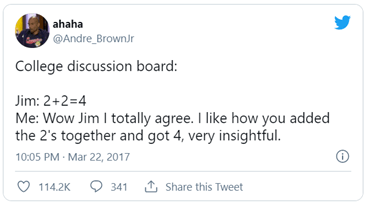
Below are two posts from Buzzfeed (Martinez, 2019). Do they sound familiar? Have you ever made posts like this or read others? (I am totally guilty of making similar posts! 😂)
Poser alert!
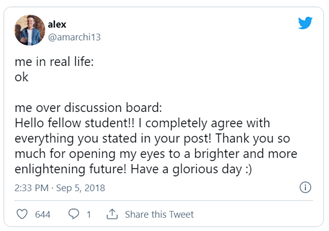
Exhibit A: Huh?
Which tip would you say this is an example of?
It cracks me up every time I read it.
(Yup, avoid praise. It wastes others’ time and does nothing to help your learning or your grade.)
Exhibit B: Really?
And how about this lovely response to Jim’s post? What went wrong?
(You got it, don’t robotically agree with or restate others’ content. It takes the conversation, your learning, and )

Use a Rubric
Want to avoid slipping into robotic and surface-level learning? Use a rubric.
A rubric helps you to focus on what’s important. It’s a set of descriptions of quality and depth to aim for in your learning. Check out this discussion rubric I use in my classes. It sets my students up for success.
Some guidance on authenticity
The third strategy, or hack, is about “being you” and most of the tips are about how to interact with others in authentic, meaningful ways.
That can get uncomfortable, because authenticity means honest responses to the course content and to others’ points.

You’re on your way!
Welcome to a world of limitless learning possibilities. Seriously.
Nothing can stop you but you when you:
- set yourself up for success,
- take charge of your learning process, and
- just be you (no posers allowed).
Change is not easy, nor should it be. You’re creating and setting new habits and ways of thinking. And it’s worth it. These are tried and true research-based strategies that will take your learning (and grades) to new heights.
Works Cited
Flanigan, A. E., Wheeler, J., Colliot, T., Lu, J., & Kiewra, K. A. (2024). Typed Versus Handwritten Lecture Notes and College Student Achievement: A Meta-Analysis. Educational Psychology Review, 36(3), 78. https://doi.org/10.1007/s10648-024-09914-w
Martinez, K. (2019, September 21). 17 Tweets about discussion board posts that are brutally honest. BuzzFeed. https://www.buzzfeed.com/kellymartinez/students-on-discussion-board-posts-who-are-honestly-trying
 itchy brain